

Moulana Syed Mustafa Hussain Circle

A Circle That Carries a History
Every town has a centre, but not every centre carries the weight of a founding story. In Alipur, that place is the Moulana Syed Mustafa Hussain Circle, an important intersection where four roads meet, connecting Arodi, Kamaganahalli, Tondebhavi and the main entrance to Alipur. For residents, it is an everyday landmark. For visitors, it offers an introduction to a village whose roots run deep into the religious and cultural history of Karnataka.
The circle is named in honour of Moulana Syed Mustafa Hussain, the Islamic scholar remembered as the founder of Alipur. According to local records, the circle was officially registered on 20 September 2011, during the presidency of Mohsin Hussain in the Gram Panchayat.
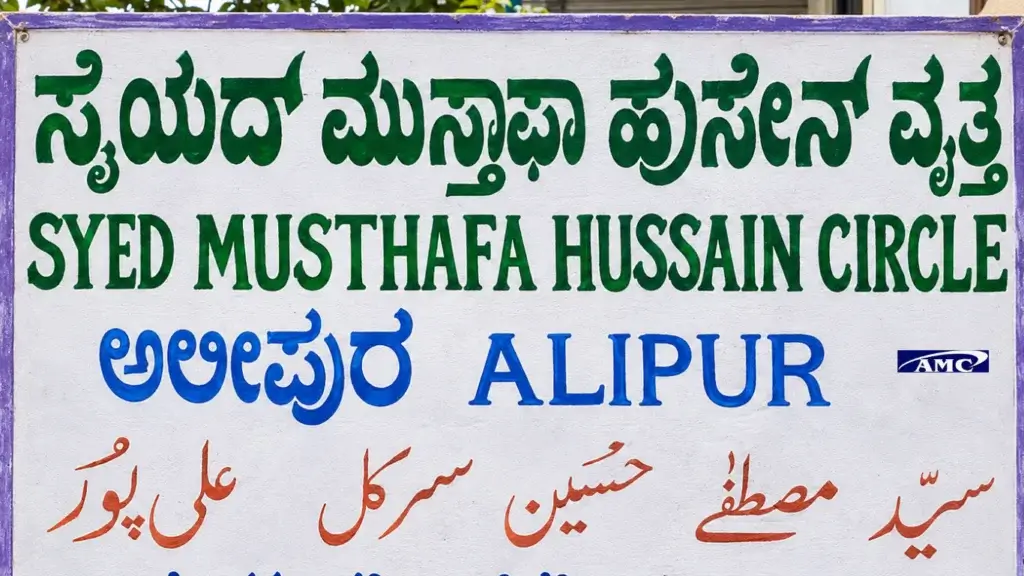
The naming of the circle was a formal recognition of the scholar’s contribution to the establishment of Alipur, preserving his name as part of the village’s public identity for generations to come.
Who Was Moulana Syed Mustafa Hussain?
Moulana Syed Mustafa Hussain belonged to the Abidi Sadat lineage, tracing his ancestry to Imam Ali Zayn al-Abidin (A.S.), the fourth Imam of Twelver Shia Islam. He was a respected Islamic scholar and is remembered as the first Aalim and founder of Alipur.
According to local historical accounts, Moulana Syed Mustafa Hussain initially intended to settle in Sira, in present-day Tumakuru district. During his journey, accompanied by his wife, Syeda Bathoola Begum, and several others, the group came across a peaceful place where they considered establishing their new home.
After performing Istikhara, a prayer seeking divine guidance, they decided to settle there.
That decision marked the beginning of a new chapter in Alipur’s history.
Moulana Syed Mustafa Hussain envisioned not merely a place to live, but a centre for Shia Muslim life in the region. He encouraged Shia Muslim families from across Karnataka to settle in Alipur, working to transform the small settlement into an established religious and social community.
Among his earliest contributions was laying the foundations of three important institutions:
- Masjid-e-Jafria: The first mosque of Alipur, established as a centre for worship, religious education and spiritual guidance.
- Behest-e-Ali (A.S.): The community graveyard, established to serve the burial needs of the growing settlement.
- Hussainiya Ashur Khana: A congregation hall dedicated to religious gatherings and the remembrance of Imam Hussain (A.S.) and the martyrs of Karbala.
These three institutions formed the religious and social foundations of the emerging community and continue to hold an important place in Alipur’s heritage.
The Historical Context: After the Fall of Bijapur
The story of Moulana Syed Mustafa Hussain is closely connected to the wider history of the Deccan and the fall of the Adil Shahi Sultanate of Bijapur in 1686.
The Adil Shahi dynasty played a significant role in the development of Shia Islamic culture, architecture, scholarship and religious traditions in the Deccan. During its rule, Bijapur attracted religious scholars, administrators, artists and families from various parts of the Islamic world, including Persia.
Following the annexation of Bijapur by the Mughal emperor Aurangzeb in 1686, the political and social landscape of the region underwent considerable change. In the years that followed, Shia Muslim families migrated to different parts of Karnataka and beyond.
These settlements included Thyamagondlu, Dobbespet, Doddaballapur, Tumakuru, Bengaluru, Shivamogga, Karimpura, Kamlapur, Sira, Narasipura, Bidar, Mysuru, Chennai, Hyderabad, Manchar, Mumbai and other parts of India.
Among those associated with this period of migration was Moulana Syed Mustafa Hussain, whose journey with his wife and companions eventually brought him to the settlement that would become Alipur.
The settlement gradually developed into the village now known as Alipur, also referred to as Alipura or Allipura. According to local tradition, its name was chosen in honour of Imam Ali ibn Abi Talib (A.S.), the first Imam of Twelver Shia Islam.
Over successive generations, Alipur emerged as one of Karnataka’s distinctive centres of Shia Muslim religious and cultural life.
Location and Road Connectivity
Moulana Syed Mustafa Hussain Circle is located in Alipur, within Gauribidanur taluk of Chikkaballapur district, Karnataka, India.
The circle serves as an important four-way junction connecting:
- Arodi
- Kamaganahalli
- Tondebhavi
- The main entrance to Alipur
Its location makes it an important point of access for residents, visitors and people travelling between Alipur and neighbouring villages. The surrounding area also serves as a centre of everyday movement and local commercial activity.
The circle is identified by a nameboard displaying Syed Musthafa Hussain Circle in Kannada, English and Urdu, reflecting the linguistic and cultural heritage of the village.
The Circle Today: A Living Landmark
Moulana Syed Mustafa Hussain Circle is more than a road junction. It is a place where Alipur’s past and present meet.
One of the notable landmarks situated at the circle is Masjid-e-Zain Al Aba, which was inaugurated on 10 March 2024. The mosque represents a more recent chapter in Alipur’s religious development, continuing the tradition of establishing places of worship for successive generations.
The presence of the mosque at a junction named after the founder of Alipur creates a meaningful connection between the village’s early religious foundations and its continued development today.
For residents, the circle serves as a meeting point, a familiar reference point and a reminder of the scholar whose decision to settle here helped shape the community.
For those arriving in Alipur for the first time, it is one of the places where the village introduces itself.
A Founder’s Legacy in a Living Community
Moulana Syed Mustafa Hussain is remembered with respect as the first Aalim of Alipur and the founder of its Shia Muslim community.
His legacy is not confined to a single building or institution. It lives in Masjid-e-Jafria, Behest-e-Ali (A.S.), Hussainiya Ashur Khana and the religious and cultural traditions preserved by generations of Alipur’s residents.
Later generations of Islamic scholars, community leaders and residents continued to build upon these foundations. Community institutions, including Anjuman-e-Jafaria, have played an important role in the administration, preservation and development of Alipur’s religious and social establishments.
Over time, Alipur grew into a recognised centre of Twelver Shia Islamic learning, religious gatherings, cultural traditions and community life in South India, maintaining its distinctive identity within Karnataka’s diverse cultural landscape.
Today, when people pass through Moulana Syed Mustafa Hussain Circle, whether travelling towards Arodi, Kamaganahalli, Tondebhavi or the heart of Alipur, they are passing through a place that carries the memory of the village’s origins.
The circle bears the name of a scholar whose faith, vision and dedication helped lay the foundations of a community that has endured for centuries.
It stands as a lasting tribute to the founder of Alipur and a reminder of the history that continues to shape the village today.
Location of Moulana Syed Mustafa Hussain Circle
Alipur, Chikkaballapur District, Karnataka, India
Latitude: 13.491708 | Longitude: 77.459369
View on Google MapsPlease Note:
Last updated: 24 November 2026
The information presented on this page has been compiled with care and to the best of our knowledge, based on available historical records, local accounts and other relevant sources. While we strive to ensure accuracy, we acknowledge that unintentional errors or omissions may occur.
As part of our commitment to preserving Alipur’s history and heritage, we welcome corrections, suggestions, additional information and historical contributions from the community.
If you have any feedback or supporting historical records, please feel free to contact us at amc@alipur.info.
Thank you for your understanding, valuable contributions and continued support in preserving Alipur’s heritage for future generations.